|
Introduction
Digitect B.V. has developed a method and underlying concepts to design,
implement, and maintain EDI messages. The method is called BPIM: Business Process
Information Modelling. Furthermore, a software application to support the method has been developed,
called EC-Design (successor of the EDIT: EDI Development and Implementation Tool). Both the method and EC-Design are
successfully applied in a great variety of business areas.
EDI messages are part of an EDI system. The role of EC-Design in the development of an EDI
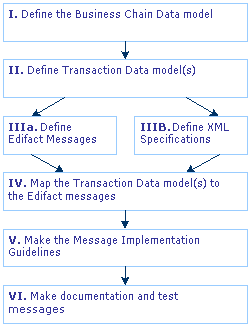
system is illustrated by the figure below. The development of an EDI system is
divided in six phases, all of which are supported by EC-Design. Each phase delivers a number
of products. These products are the output of EC-Design. The output of
EC-Design is thereby for instance 100% consistent documentation. The documentation is modular
and consists of several parts.
The method in brief
The method is based on the separation of functional requirements and the realisation of
those requirements in a syntax like the EDIFACT (EDI For Administration Commerce and
Transport) or XML syntax. It contains the following elements:
- functional requirements by means of a data model and a process model. The data model
represents the business processes and the products or services supported by those business
processes. The process model is a set of transactions between actors to exchange
information regarding the behaviour of the business process ('where are my products');
- realisation of the functional requirements in EDIFACT or XML;
- production of Message Implementation Guidelines, either for sectorial use, international
use, national use, or the use by two actors;
- the implementation of messages by generating translation tables and test messages.
Development is speeded up by using standard elements that have already
been specified. Those elements are contained in repositories. The object repository
contains actors and standard objects with their properties, the model repository contains
standard transactions, entities with their attributes, and constraints on attributes (e.g.
domains and code values), the mapping repository contains standard mappings of entities of
the object repository to elements of the EDIFACT repository, and the EDIFACT repository
contains the TDID.
Elements of EC-Design
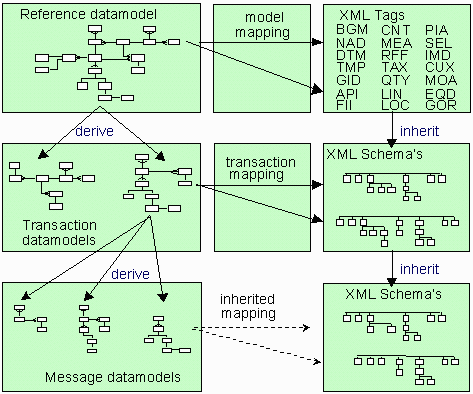
The elements of EC-Design are shown in the figure on the left page. We will first define the
terminology.
Business process data model
This data model describes all information that is exchanged between actors in order to
support the business process between those actors.
Transaction data model
A transaction data model specifies the information requirements of one transaction It is a
view on the business process data model.
Functional message
Each individual message function in a transaction, specified by a user group, is called a
functional message. A functional message is defined as a view on the transaction data
model.
EDIFACT message
An EDIFACT message defines the structure for the exchange of information in a transaction
and is part of a Trade Data Interchange Directory (TDID). Each TDID consists of a message
directory, segment directory, (composite) data element directory, and codelists.
Mapping
A mapping of a transaction data model to an EDIFACT message describes the conversion of
information in the transaction data model into the syntax of the EDIFACT message. A
transaction data model can be mapped to multiple EDIFACT messages.
Users and User group
A user is an actor which implements one or more functional messages. A user group is a
number of users which have agreed to introduce EDI by means of one or more functional
messages.
|